


What Is Kitchari? An Introduction to Ayurveda's Healing Superfood.

If you're new to Ayurveda, its only a matter of short time before you hear of kitchari. This is because Ayurveda absolutely loves it, I mean it loves many things as you might have guessed, but Kitchari is really special. So what is it? Well that’s what we are going to find out and explore, let's start with the basics.
What Does "Kitchari" Mean?
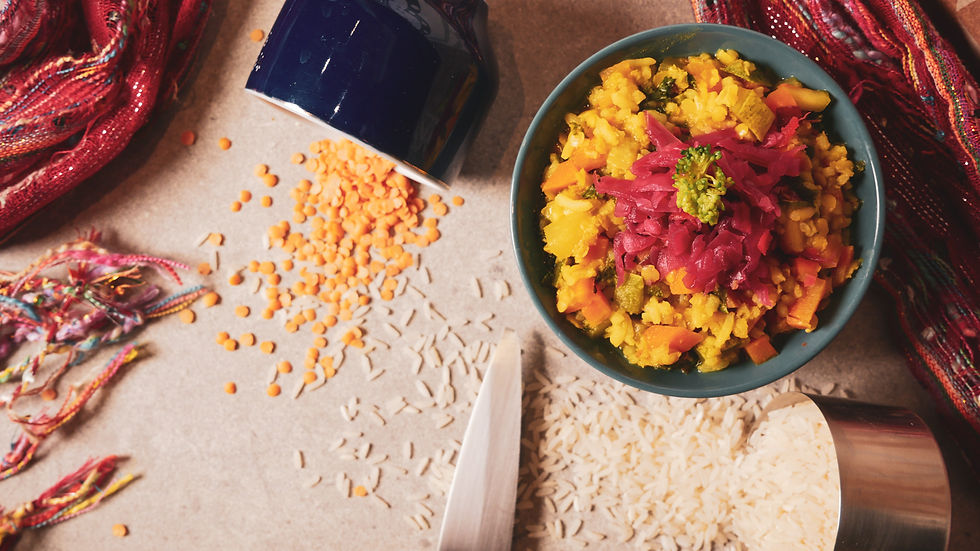
Kitchari comes from the Sanskrit word for mixture, and that's exactly what it is: a simple blend of rice, lentils, and digestive spices, cooked together into one nourishing dish. I repeat kitchari is essentially a mixture of rice, split lentils, ghee, digestive spices and water that is cooked into a porridge or soupy consistency.
Interestingly enough, some version of a rice-and-legume appears in nearly every culture where rice and legumes are grown. This is not a coincidence, rice and legumes complement each other beautifully. Together, they form a complete protein, containing all nine essential amino acids, while the legumes' fiber slows down how quickly the body absorbs sugar from the rice. It's a combination that has quietly sustained people around the world for centuries, and Ayurveda builds on that same wisdom. Let us know any versions this rice and legume dish that is present in your culture, I’d be curious to read some of your answers!
So what Is Kitchari Made From?
Traditional kitchari is made from just a few ingredients:
White basmati rice — considered in Ayurveda to be the easiest rice to digest.
Split mung dal (mung beans) — considered the easiest legume to digest.
Digestive spices — warming spices that support the body's digestive fire.
Ghee — clarified butter, added for deep nourishment.
Water — used to cook everything down into a soft, easy-to-digest dish.
Both the rice and the mung dal are used in their split, hulled form, meaning the tougher outer skin has been removed. That's an intentional choice, the outer husk of a seed is harder for the body to break down, so removing it makes kitchari significantly easier to digest than a typical rice-and-bean meal. Actually ayurveda considers the the hull or skin of all legumes to be the hardest part to digest and the part that contributes the most to bloating and gas, fun fact to know.
The Basic Ayurvedic Benefits of Kitchari
Kitchari is considered tridoshic, meaning it's balancing for all three dosha: Vata, Pitta, and Kapha alike. That's part of why it's so widely used in Ayurveda, it's gentle enough to suit nearly everyone.
A few of its core benefits:
It's easy to digest. Because the body doesn't have to work hard to break kitchari down, it frees up energy that can be used for other things—like rest, healing, and repair.
It supports digestive fire (agni). The spices cooked into kitchari are warming and help keep digestion functioning smoothly.
It's nourishing and grounding. Between the rice, lentils, and ghee, kitchari provides real nourishment rather than leaving the body depleted.
It's gentle on a sensitive system. This is part of why kitchari is traditionally given to babies, the elderly, and anyone recovering from illness—it can be made thinner and soupier for those who need something especially easy on the body.
It's a foundational part of Ayurvedic cleansing. Kitchari is often used as a mono-diet, meaning it's the only food eaten for a period of time to give the digestive system rest.
That last point is worth sitting with for a moment. In Ayurveda, cleansing isn't about depriving the body or purely focused on scraping out toxins. It's about cleansing and rejuvenating the body together at once. Its also about giving the body the space and providing the ideal environment it needs to reset and go about its natural physiological processes. Kitchari plays a central role in making all of what I just mentioned about cleansing possible.
A Simple Dish With a Lot to Offer
At its heart, kitchari is proof that healing food doesn't need to be complicated. A few simple ingredients, prepared with intention, come together to create something deeply nourishing for our entire being.
This is just a brief intro to what kitchari is. Kitchari is really like an Ayurvedic superfood and can be such a valuable tool to reset and bring balance on the physical, energetic, emotional and mental level.



Comments